


TPR here shares remarks from an October 20 press conference at Palisades Village, where Mayor Karen Bass, Caruso founder and executive chairman Rick Caruso, Board of Water and Power Commissioners President Allan Marks, and LADWP Interim General Manager Dave Hanson marked six months of Executive Directive 19, the Mayor’s push to streamline permitting citywide.
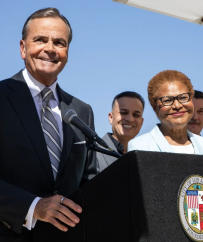
Palisades Village, Pacific Palisades | October 20, 2026
Speakers: Mayor Karen Bass; Rick Caruso, founder and executive chairman, Caruso; Allan Marks, President, Board of Water and Power Commissioners; Dave Hanson, Interim General Manager, LADWP
Mayor Karen Bass: It is great to be here today with all of you. I first want to recognize Rick Caruso for his commitment not only to helping Pacific Palisades rebuild, but to supporting development across the city. Our partnership has helped fast-track improvements and rebuild community spaces so Palisadians can return home. Making sure that sense of community is there also plays a role in restoring hope and encouraging others to rebuild and return. Angelenos across Los Angeles also benefit from new investment, stronger neighborhoods, and a city that continues to grow and thrive.
As a leading developer in the private sector, Rick brings valuable firsthand experience of the challenges of building in our city. We appreciate his partnership and his willingness to help advance solutions that make development more efficient and effective. This collaboration shows what we can accomplish when we work together: cutting delays, lowering costs, and getting projects moving faster. That’s what today is about: getting things done for Angelenos.
For decades, our city has struggled with a development permitting process that is too fragmented, too unpredictable, and spread across too many departments. The city’s permitting infrastructure remains a barrier to development. Applicants must navigate siloed departments, each with its own requirements and touchpoints, creating delays that can make projects financially infeasible and drive investment to competing jurisdictions.
Six months ago, I issued an executive directive with one clear goal: make it easier to build in Los Angeles. Executive Directive 19 takes a comprehensive approach to development services across three areas — technology, process, and customer service — to modernize and streamline how the city reviews and processes applications. Taken together, these reforms build on the city’s ongoing commitment to housing production and reflect lessons learned from other reform efforts. Today, we are taking another step forward and delivering on the promises of ED 19.
I’m here to announce Power Ready LA, a comprehensive effort to transform how LADWP delivers utility services to commercial and residential projects so they move faster and more predictably. This effort will lower upfront costs for eligible housing and commercial projects and create greater certainty for developers planning to build in Los Angeles.
Through ED 19, the Department of Building and Safety has expanded self-certification for eligible commercial tenant improvements citywide, helping small businesses move projects forward. We’ve also taken the pre-approved standard plans for single-family homes, first introduced to support rebuilding in the Palisades, and made them available citywide.
We’re already seeing progress on our broader housing goals. The city has issued 10,000 certificates of occupancy for affordable housing. In the last four years, we’ve built more affordable housing in LA than had been built in many years, including through the Adaptive Reuse Ordinance, which converts office buildings into housing, and we’re doing that all around LA.
We’re making utility connections more predictable, improving customer service, modernizing outdated processes, and giving developers the tools and support they need to move projects forward. Together, we are making it easier to build in LA.
With that, I want to introduce Rick Caruso, who, as I mentioned, has been a key partner in identifying the challenges in our development process and in addressing them, so that LA can build faster and more easily, and developers won’t say, “I’ll build anywhere but LA.” We want developers building right here in the city.
Rick Caruso: Thank you, Mayor Bass. I’m excited to be here. I think everybody understands my reputation: when something is good, I’m going to back it up, call it out, and congratulate the good work. And if I think something is damaging the city, I’m going to be honest and call that out as well.
This is a great step. What’s been great about working with the mayor, her office, and her team is that this village became something of a test model for expediting a whole array of permits at once, and we went through that process with great speed.
What is so hopeful to me is this: if you drove up here today, you noticed we have traffic on Sunset. That’s a good thing. People have moved back home, businesses have reopened, and a lot of it is construction. You see the construction behind me. Honestly, that traffic wouldn’t be happening if it weren’t for Mayor Bass and her leadership in cutting through red tape.
Taking what we’ve learned in the Palisades citywide is so important. As developers, we are frustrated with the time and cost it takes to build. The only way we’re going to reduce the cost of housing and the cost of living in Los Angeles is to build more and to build quickly. That cuts costs on the development side, which can translate into lower costs for housing and apartments.
So it’s a great day. Thank you for your leadership on this, and for all the help you’ve given to the Palisades and Palisades Village. I love having buildings going up behind us.
And this gentleman here has been a superhero: the new head of DWP. I called the mayor privately and said, “You made a great appointment.” We’re seeing the hookups for people’s homes out here, and it has changed dramatically. So thank you, Dave.
Allan Marks: Thank you, Rick, and thank you, Mayor Bass. Good afternoon, everybody, and thank you for joining us here at Palisades Village. I’m glad you highlighted the construction behind us. We need to see more of that, and we are going to see more of that. Let me share what DWP is doing specifically to make a difference.
When we stood together at DWP headquarters downtown back in April and you signed Executive Directive 19, it was very clear that a lot needed to be done. Too often, the Department of Water and Power had become a point of friction and delay for people trying to build and connect new projects. That was true for single-family homes, for multifamily and mixed-use developments, and for commercial hookups.
At the time, projects had to go through dozens of handoffs to be energized. Our engineers spent too much time responding to status inquiries from customers who were left in the dark, time they should have been spending reviewing, designing, engineering, and processing approvals. Management had already identified specific pain points we could address to work through that backlog and accelerate development across the city. ED 19 allowed us to massively accelerate those efforts, not just for the Palisades rebuild, but for new residential, multifamily, and commercial projects across Los Angeles.
As president of the Board of Water and Power Commissioners, I have the privilege of leading the commission that provides policy direction and oversight to LADWP. My fellow commissioners and I passed a resolution directing staff to implement ED 19, and we remain fully committed to its full implementation. We have to ensure LADWP is doing all it can to promote growth and economic well-being in Los Angeles.
I’m proud of the change we’ve already seen and of what our teams have accomplished in the 176 days since ED 19 was signed. I see real change in how new construction and developments are getting energized: a strategic shift toward what our customers actually need, which is more predictability, more certainty, and more speed.
Some of you have heard me talk about the first steps we took over the summer. We hired more engineers and staff. We set up internal dashboards. We created pre-engineering templates. And, as the mayor mentioned, we have pre-approved designs for single-family homes. We now also have self-certified and pre-approved engineering templates for larger, more complex projects. All of this makes development more predictable, more standardized, and quicker.
Let me outline five more measures worth highlighting today.
First, three weeks ago our Board of Water and Power Commissioners voted to allow LADWP to absorb 100 percent of the cost of line extensions to connect new customers and developments to the grid. Customers will now share costs only for projects with unusually high electrical load, or for the last leg of an extension that would serve only one customer. I want to emphasize that this is a momentous change. It will lower project costs, shorten development timelines and construction clocks, reduce the back-and-forth, and support new development citywide.
Second, we’ve launched and are now accepting applications through the beta version of Power Connect, our new online portal that centralizes project information and communication. Customers can find the information they need in one place and get a clear picture of project status, next steps, and who is responsible for taking them.
Third, customers can now get a preliminary meter panel earlier in construction. That means they can plan foundations, grounding, and electrical work earlier, without waiting until framing is complete.
Fourth, we’ve released updated construction work area standards that allow customers to use the public right-of-way for staging. This is huge. Previously, many customers had to set aside land on their own site for staging. Now they can move faster, use the public right-of-way, and potentially create more usable floor area and more valuable frontage.
Finally, we’ve formed a new advisory group of developers and contractors who will give us input and tell us what we can do better going forward.
We’re already seeing results. We’ve reduced our late inventory by more than 800 projects since the August peak, while still taking in 870 new applications every week.
A friend of mine who builds housing in LA and other cities recently told me how pleasantly shocked he was by what he called a cultural transformation at DWP. He said the city was open for business in a way he had not seen before. Then he asked me what is now my favorite question: “Why wasn’t this done 20 years ago?” I could only answer, “I have no idea, but we’re doing it now.”
Let me close with a few words of gratitude. No single agency can do this alone. We’re part of a city family, and ED 19 calls for active coordination across city departments. LADWP, Public Works, Engineering, Street Services, and Building and Safety are now collaborating more holistically, which speeds projects along and gets approvals processed more quickly.
Let me be crystal clear: our work is not done. There is much more to do to build on this progress. So let us know how we’re doing. If something produces a better outcome than before, tell us. If it doesn’t, or you have a suggestion, tell us that too. As we communicate with new clarity, respond more quickly to requests for design approvals and inspections, and further streamline and modernize our processes, our main KPI is customer satisfaction. Our customers deserve an efficient, modern, and predictable process for new connections and real estate development. That is our commitment to you and to Los Angeles. Thank you very much.
- Log in to post comments