


This past June 17th, fire broke out at the roughly 500,000-square-foot Lineage cold storage facility on the seam between Boyle Heights and unincorporated East Los Angeles. It burned through reignitions until knockdown on June 24, prompting a number of shelter-in-place orders and emergency declarations from both Mayor Bass and Governor Newsom. TPRVX, to better understand the Impacts and response, spoke with Carmelita Ramírez-Sánchez , executive director of the Boyle Heights Arts Conservatory, which operates a neighborhood resilience hub, and Catherine Baltazar, associate director of advocacy and organizing at Climate Resolve. The focus is on the response, the jurisdictional gaps it exposed, and why implementation, not legislation, is the binding constraint.
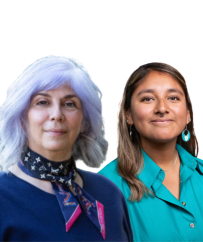
“That’s one of the differences you see in this emergency, that people were not willing to wait until word came from on high about who was going to take care of it. If you need us to handle an emergency and we are the boots on the ground, give us the tools and trust that we’re going to do the correct thing with them.”
Understanding that this interview is being recorded with both of you as the Lineage Fire’s tragedy continues to unfold, please address where impacted communities are now in the evolving coverage. Have any heroes or villains been identified?
Carmelita Ramírez-Sánchez: Ever evolving, still evolving. In our communities there are the uninformed, the slightly more informed, and those who think they’re informed. I’m not sure that has anything to do with heroes and villains.
Perhaps it is best for both of you to introduce yourselves and your organizations to our readers, including your relationship with USGBC, a legacy partner of the Boyle Heights Arts Conservatory.
Carmelita Ramírez-Sánchez: I’m executive director of the Boyle Heights Arts Conservatory. Our relationship with USGBC spans before we were even a technical resilience hub, in that we have had a long-term relationship with the organization, and we are probably nearing 10 years of working with the US Green Building Council.
Catherine Baltazar: I’m associate director of advocacy and organizing at Climate Resolve, a Los Angeles-based nonprofit advancing equitable solutions to climate change, with a particular focus on extreme heat and climate resilience. We’ve been long-term USGBC partners on heat pumps and building retrofits, and Climate Resolve led much of the advocacy behind the cool roof ordinance a couple of years ago.
To the topic of the day: the fire began June 17 at the cold storage facility on Los Palos and burned through reignitions until June 24. Residents were told to shelter in place within the first day; by June 20, the city and the state had declared emergencies. Carmelita, walk us through: how the Conservatory became involved, your focus, and what was prioritized?
Carmelita Ramírez-Sánchez: Absolutely. The Conservatory’s primary focus is workforce development in the creative arts, so our first role is always in the work that we do to create the opportunities for young people to understand their place and how we can have an ecosystem that surrounds the creator. With that in mind, the resilience hub grew out of work we’ve been doing since 2011, and any disruption in our area whether that be an ICE raid, an active shooter, extreme heat, or any disruption of a regular stack flow, if you will, it immediately activates it.
We saw the plume within minutes, because it engulfed the entire area. At that particular time I was at the California Endowment doing a walkthrough for workshops we were hosting: on one side was my team, on the other our home base was calling to ask whether we should send everyone home. What were we supposed to do? Those first hours were confusing, because there was no official word — nobody came on and said, “This is happening.” Within about 90 minutes we activated the radio station, and we were careful not to put out information we didn’t have. What did we know? We knew there was a fire, roughly where it was, that questions were coming, and that we knew to look out for city and county officials who should have been giving information. We had far more that we didn’t know than what we did. So on our end, that's what we were focusing on the radio, and being very careful not to give information we didn't know.
We got back into the office at around 4:30, and we decided not to close — to keep the Conservatory open and most importantly to activate the resilience hub. That gave us about 12 hours to stock masks, air purifiers, and information. I spent a lot of this time on the phone and going to partners while the rest of the team was out at stores; there wasn’t a run on masks yet, so we could move fairly quickly. Then we announced on social media that we would be open, specifically to provide fresh (or fresher) air thanks to our entire building having a hospital-grade HVAC system. We were able to provide personal protection children’s and adult sizes, so anybody could come by and pick up a box of either or both and then we were able to at least start having some information.The first city official to actually reach out to us was our council member Ysabel Jurado’s office, within a few hours. She asked: “Do you need anything?”, What are we doing? If they didn’t have something, they sent people to us. In the days after we were still waiting for official understanding of what was happening, and it was coming in and not coming in. But, what you did notice immediately was the prominent smell and the immense smoke blanketing East Los Angeles and Boyle Heights.
You’ve said much of your work in those first days was with area businesses. Were they responsive?
Carmelita Ramírez-Sánchez: Yes. We went door to door immediately with PPE, filters, and signage so they knew to keep their doors closed — most businesses in summertime prop them open. Having that conversation in Spanish was very helpful to them. We ended up doing a great deal of that outreach in the initial three to seven days, because the commercial sector fell through the cracks much more than residential outreach did.
Speak to the value of your communities’ Resiliency Hub long championed by Climate Resolve. By design, its purpose is to centralize resilient operations, and resilient communications like your radio station. Was your Hub first activated in response to the fire?
Carmelita Ramírez-Sánchez: No — the hub has actually been activated multiple times. Our very first action as a resilience hub, though it wasn’t titled that yet, was an active shooter event on our corner, where we provided immediate information and shelter for people out on the streets. We've been activated for ICE raids, for extreme heat, and for senior citizens who needed to get inside during a change in weather. We are not based only on climate-shift disturbances. Any disturbance we can address is what activates us.
Carmelita, what about the Hub worked when activated? What didn’t? And what lessons are you learning?
Carmelita Ramírez-Sánchez: Well, the lessons are still being learned, but what worked was that the system was already in place. We built it with Climate Resolve: you identify the category of emergency and you know what to activate, starting with having the PPE ready. We took a little of what we learned in COVID, a little from extreme heat, a little from active disruptions in front of our space, and we have a toolkit we created with Climate Resolve for these situations.
Another thing that worked really well was that we also knew people would need somewhere to go. It’s summer, the schools aren’t open, and our primary library is closed for construction, so you can’t even shelter there. They came, and they needed Wi-Fi, the ability to work on site, and parking, which our nonprofit partner in the same building provided. So, what worked is what always has worked, which is getting that system activated right away.
What worked less well was the messaging. There were a lot of opposing messages from the county, the city, and our own district — the council office, the county, and City Hall. On the radio that meant real due diligence: when one person says the air outside is safe, another says it isn’t, and a third isn’t answering the phone, we have to highlight the information that is actually needed. It meant concentrating on logical information. Should you be outside? Logically, no. Should you stay indoors? Probably not. If you’re in the immediate area, which other partners can help? That didn’t work as well, because the information was scattered and confusing. Where it worked best was in our city council, and where it worked worst was at the county level.
Catherine, let’s return both to the subject of information gathering and the distribution of information as well as Climate Resolve’s buffer zone project.
Catherine Baltazar: The buffer zone project came out of engagement around the Boyle Heights Community Plan update a few years back. A community plan is the neighborhood-level document dictating how development happens: anticipated population shifts, what housing gets built, where and why, density bonuses. It is essentially the development document for the community. The last time it had even been looked at was in 1980 when it was published. And so from there to 2020, at the time we started doing engagement around the community plan, it had been 40 years and 40 years of growth in the community, 40 years of changes in the community, and it’s supposed to project out 10 years — so what that document represented historically is no longer what it represents now. You also have to keep in mind that the community is very close to the Arts District, which has been gentrified and where a lot of wealth is coming in. What does development in Boyle Heights look like when people don’t want to leave and shouldn’t have to be pressured out?
So, when we did the plan update we talked about what the community needs and about resilience measures. This was the first time we really thought about climate change in the context of development. Does that look like building affordable housing that's multi generational, meaning affordable housing that's bigger than just one bedroom? Most families in Boyle Heights are multigenerational, so they need bigger spaces that still retain affordability. A lot of residents want the parks they have available to be invested in. So, it became the first time the community looked at resiliency from a non-siloed perspective. In the past you focused only on trees and greenery, or looked at housing and transportation only through those lenses. The buffer zone was the first time we talked about protecting part of the community through trees, active transportation, housing, and cool surfaces at once — taking all the feedback we’d heard and putting it into one project.
What the fire does to our Buffer Zone Project is expand that framing rather than change it. The industrial buffer zone didn’t begin solely as an extreme heat project; it grew out of engagement where residents were already identifying incompatible land uses and cumulative environmental burdens. Extreme heat just happened to be one part of that larger conversation, when we're looking at things that are helpful in adaptation around extreme heat, like tree canopy and reducing heat exposure, adding more shade, more cool surfaces. That's just one piece of it.
What the Lineage fire brought up in this situation, as it relates to our Buffer Zone Project, is another dimension of vulnerability impossible to ignore: what happens when industrial activity exists immediately alongside homes, schools, and parks, essentially where people live their daily lives. Our project has components focused on protecting residents adjacent to industrial uses and adapting to those needs.
In that spirit, AB 98 took effect January 1st, imposing setbacks and landscape buffers — but apparently it doesn’t apply to the Lineage situation in Boyle Heights. What’s none-the-less needed, and what are you working on to provide the conditions for a livable community?
Catherine Baltazar: AB 98 is significant because the state is acknowledging something environmental justice communities have said for a long time: where we site logistics and industrial facilities matters, and proximity to homes and other sensitive uses can have real public health consequences. That has been the lived experience of many environmental justice communities — not just in Boyle Heights or East LA, but in other parts of the state.
So, AB 98 is the acknowledgment of that. But I think the challenge is that AB 98 is for new development, and Boyle Heights is already largely built out. We’re not asking how we will design the next warehouse differently. We’re asking what happens when incompatible land uses already exist, and what resolves that problem now. That’s where we have to distinguish between creating a policy and creating an implementation pathway for Boyle Heights. They’re not starting from zero: we have Clean Up Green Up and the community plan update, each with its own implementation tools, and then we have you know AB 98. These are meaningful advances — don’t get me wrong. But putting protection on paper doesn’t automatically undo decades of land use decisions or change conditions on the ground today.
So,, when I think about what needs to be changed, it’s really when we think about the implementation. Who is responsible for carrying this out, and is that explicitly included in the legislation? What resources are available? Enforcement is always key — the risk is that it doesn’t get funded, doesn’t get assigned to anybody, or gets rolled under a different process. And what happens to existing facilities? Are there incentives or technical assistance to help those businesses transition? What happens to workers? A lot of what we’re hearing with the Lineage fire is whether it should come back at all. I’ve been on the ground with community members who say it should not, because of all the environmental justice issues. I’m also hearing from folks who work there that if this industry leaves, those workers won’t have jobs or economic opportunity. There are a lot of factors contributing to how we look at policy, and I think that’s the piece that gets overlooked.
From the reporting to date, residents didn’t wait for the agencies – these communities placed their own air sensors in neighborhoods, launched UCLA- and South Coast AQMD-affiliated monitoring, and conducted LA River runoff sampling. How was that void filled before the agencies came in – if they’ve now come in?
Carmelita Ramírez-Sánchez: I don’t know all the details, I’m going to speak to the micro, not the macro.
I can say the biggest challenge when we started making phone calls was jurisdictional: whose district is this, technically? Most of the site is in unincorporated East Los Angeles, but the address faces Boyle Heights. So what we came across was officials saying, “That’s not my area, I can’t help.” Or: if you’re distributing air purifiers, make sure the people coming are from this side of the ZIP code rather than that side.
We threw all of that out the window and let our representatives know it wasn’t going to happen. If you give me 10 air filters and 10 families come — from Boyle Heights or from East LA — we’re giving them the air filters. That may have been a little shocking for the agencies, because they wanted everything in a very clean box: county person, county resources; our assembly member, that assembly district. We couldn’t abide by that.
That’s one of the differences you see in this emergency, that people were not willing to wait until word came from on high about who was going to take care of it. If you need us to handle an emergency and we are the boots on the ground, give us the tools and trust that we’re going to do the correct thing with them. That’s what is important about being an organization with a resilience hub: we have to set things up for years, so that trust is already ingrained. That’s the challenge with a lot of these agencies — the trust is not ingrained. You can trust that you’ll come to us and we’ll give you your mask and your air purifier. You can’t necessarily trust that the agencies coming into our neighborhoods will do what they say they’re going to do.
Catherine, please elaborate. Are you saying that the public agencies charged in an emergency with being there have such strict requirements that it’s very difficult for residents impacted by events like the Lineage Fire to rely on them?
Catherine Baltazar: Across a lot of the communities we work with, there’s a general mistrust between the community and local government, and that comes from histories of decision-making that have continuously hurt communities, or that served broader development or citywide benefits in ways that affect communities locally.
When I was thinking when you mentioned monitoring, one thing we’ve learned at Climate Resolve is that data that is available to people doesn’t necessarily equate to data that is relevant to them. Agencies have monitoring responsibilities, and I remember reading that they deployed some monitoring during the incident. But what’s important is giving the community something tangible to connect with. At Climate Resolve we do participatory science — sometimes called citizen science, though we don’t use “citizen,” because we want to be aware of our undocumented neighbors. It adds the community monitoring piece: collecting information at the neighborhood scale, in places residents can recognize, and creating a process where lived experience helps us understand what those measurements mean.
At a tabling event this past Friday at Evergreen Park, we asked community members three questions: How informed are you about the air quality in your neighborhood? Where are you getting that information? And do you trust that information? Consistently we heard, “Well, sometimes I trust it, and sometimes I don’t.” Their information came from TV — Channel 34, Univision, or Fox 11, which was another interesting channel for us — and from mail from the city or the county, depending on where they lived. When we asked them why only sometimes, they said: we were told many times that the air quality was good, but I’m out here having headaches and a hard time breathing, and we can visibly see the smoke.
That’s the piece community monitoring helps bridge that. When there’s a disconnect between what residents are told and what they experience, like headaches or respiratory concerns, it doesn’t necessarily mean the monitoring at the agency level is wrong. But it creates the conditions to treat that discrepancy as the beginning of a question rather than the end of a conversation, and to ask where we may need a more local-level sensor to pick up exactly what is being emitted, because obviously there is a disconnect. That should be the conversation agencies like South Coast AQMD and CARB are having, because monitoring at the regional level may not indicate what we’re seeing at the hyperlocal level, something that is just as relevant for the people living it day to day.
Carmelita, the community to date has spent three decades dealing with effects of the Exide Accident. Assist those reading this interview— officials, investors, developers who site and finance facilities like the one on Los Palos — to understand: why do so many of your neighbors assume, before any public agency arrives, that no one is coming?
Carmelita Ramírez-Sánchez: Because that’s what we know. However, I would say that there are ways that we can work together, to have these conversations. The conversations always happen after the disruption, when what we should be investing in is in conversations beforehand, and not necessarily town halls and different factors that are coming together because even when you say before any agency arrives, which agency?
There really isn't even a clarification on what agency is supposed to be arriving. And once they arrive, what is their role? So one of the things that we are really advocating for, and this is where the radio station comes in, is we are a place where people can have these conversations. But we cannot be the only place, nor should we be the only place where people can have these conversations. The conversations on what is going to happen to that site, how is it going to be cleaned up? What comes in its space? And again, not just from the neighborhood point of view, because much to Catherine's point, these are job opportunities for many people. A building or a resource or any kind of industry that is there, provides jobs. So we cannot have a complete, scorched earth approach that no businesses could be coming in and out. However, we can have intelligent conversations about this. We can have conversations where we don't have a fixed mindset on what we want or don't want to go in there. I definitely think that that should happen, and in some circles it's already happening. However, it should happen much sooner than it normally does, and it should happen in a way that's accessible and in a way that doesn't just pay lip service to our communities.
Permit applications have been filed, drawing anger from residents and city leaders who say cleanup should come first, and in response the Mayor has directed departments not to process them. But Lineage only leased and operated the building. The parcel is owned by Chill Build Los Angeles I LLC, which says Lineage is responsible for the facility and for the recovery. Explain to our readers how to balance/allot responsibilities. What are lessons that need to be learned and the practices that have proven successful?
Catherine Baltazar: That question almost gets directly on what we just talked about with Exide, decision-making and the community being incorporated in the process. Lineage isn't the first environmental justice crisis Boyle Heights has experienced. If policymakers, in this case, really want to take incidents like this seriously and to become less common, we really have to change exactly what Carmelita was saying, is when and how community knowledge enters that decision making process. Communities shouldn't have to wait to experience a disaster before their concerns are considered legitimate.
With residents, especially, like in communities, like Boyle Heights, they're already empowered, organized and activated. There's a lot of generations of environmental justice advocacy because of exide. Sometimes what I hear is that, well, residents haven't spoken up, but that's not true, we have that history. I think the question is whether these institutions/these agencies have the ability to listen, and make it clear to residents, whether what they say can get approved, can get funded, can get built, and can get enforced, and that there's a transparent process throughout the whole state.
Sometimes agencies opt to do community engagement, but community engagement and community influence are not the same thing. You can hold 10 meetings or you can translate all the documents and all the notes that came out of that, you can collect all the public comments, and those are important practices, don't get me wrong, we can do all of that, but if you're going to do all of that and still make the same decision without taking those comments into account, then you're kind of just doing the process for the sake of checking off a box.
Before we end this very instructive interview, there appears to be a consequential difference between the approach of Catherine and Carmelita to the recovery challenge. Environmental justice concerns have long been fiercely advanced, but are often viewed by many in business as advocating scorched earth solutions. Carmelita, on the other hand, you have said, jobs and employment must be saved even as we don’t want an Exide in our neighborhood. Have there been any constructive civic conversations about how to reconcile both concerns? Perhaps, in framing policy priorities as either/or, competing interests are setting this up so that anybody who doesn’t take a 100 percent position on one side or the other is deemed not to be listening?
Carmelita Ramírez-Sánchez: Yes, and no, because we have 2 different factors. We have people that have been having this conversation for so long that they know nobody's listening. And then we have people that don't know how to have the conversation, so are just going to scream till everybody listens. Those are not mutually exclusive. My thoughts are that we need to stop having “if” conversations and have “when” conversations. This is Los Angeles. It’s not if we have another earthquake, it’s not if we have another fire. It’s when.
So to have those conversations in an honest way, there has to be an investment in how we have the conversations. As Catherine said, it's not a checkbox. There are organizations and people that have been fighting environmental racism in our neighborhoods for decades for their mothers, mothers, mothers.
Gloria Molina.
Carmelita Ramírez-Sánchez: Rest in peace, absolutely. So let’s put some thought into how we create these forums. I also strongly believe — whether because of our own background, or the way that, dare I say, manners are taught in our familias and in our heritage — that we are open to having these conversations in a civil way. Our ancestral knowledge tells us that respect and peace are really the way to have these conversations. So if we approach it in a restorative, culturally responsive way, in a way that is familiar, or at least taps into our ancestral knowledge of what a conversation should be — that is the approach I would advocate. Not big town halls with cameras everywhere and flyers going out. Sure, that’s what we’ve always done, and it has worked not at all for us.
Catherine, do you want to add something before we close out?
Catherine Baltazar: Carmelita took the words out of my mouth; I can only agree with exactly what she said. There’s a lot of anger in these communities, and you have to process through it. The more we try to pretend it doesn’t exist, or that people don’t have a right to be angry, the more that anger increases. So being able to have intentional dialogues is going to be important in any community that already has conflict with its government, or that has been dealing with decades of environmental injustice.
- Log in to post comments