


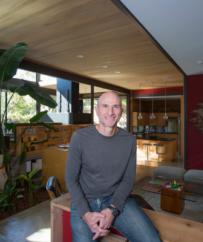
“Between macro conditions, political and legislative changes, and rebuilding needs…we’re in a strong position to grow, thrive, and—depending on how the market consolidates—either merge, sell or potentially go public.” – Steve Glenn
As wildfire rebuilding, affordability pressures, and labor constraints converge, off-site construction is moving from niche solution to market necessity. In this interview, Founder and CEO of Plant Prefab, Steve Glenn, reflects on two decades in industrialized housing, tracing how prefab has evolved from design experimentation to a delivery-driven business shaped by automation, permitting frameworks, and capital discipline. Glenn walks through the mechanics behind prefab’s time and cost advantages—underscoring where complexity, customization, and regulatory friction remain unavoidable. Looking ahead, his message is pragmatic: prefab will not solve the housing crisis alone, but execution, standardization, and policy alignment will determine whether the sector can deliver at the scale the market now demands.
Steve, when we last spoke, you shared that Plant Prefab was scaling its operations and positioning prefab as a structural solution to California’s housing crisis. Share how the company has evolved since.
To clarify, I certainly didn’t mean to imply—that we are the “solution”. But I do believe off-site construction will be an important part of the solution.
Plant Prefab had a good year. We’ve been growing pretty quickly in terms of new projects, and we’ve seen a lot of interest in affordable housing. We finished—or I should say shipped—our first affordable multifamily project last year. It was a 13-unit project with Brooks + Scarpa for Community Corp of Santa Monica, and it went well. The general contractor, Howard CDM, estimates we probably saved about 30% on the schedule compared to a traditional site-based process.
We’ve got a number of other multifamily affordable housing projects underway. Then the fires happened, obviously, about a year ago, and we now have 66 [it’s now 87 – we signed more in the last two weeks, so not sure if you want to include that] single- and multifamily units under contract. That includes several multifamily affordable housing projects in Altadena. As a class, rebuild projects are now the largest single category of work we’re doing.
We feel fortunate to be in a position to help. We operate the only high-volume, automated prefabrication facility west of the Mississippi that is available for single family home construction. There’s only one other automated plant in California, it’s in Northern California, and they focus on multifamily. We’re in Arvin, about an hour north of Los Angeles.
Historically, our founding premise was to make architecturally customized projects more efficient to manufacture. Many of the areas that were impacted by the last year’s wildfireds—Malibu, the Palisades, Altadena—weren’t developed by large production homebuilders. Most of the lots aren’t standardized, so homeowners need customized solutions to match their lots, footprints, and elevations, particularly since you can qualify for expedited permitting and avoid coastal commission review if you’re in a coastal zone as long as you project falls within 110% of the building envelope of the original structure,
So we’re in a unique position to help, and we do feel fortunate about that.
Steve, before I ask about the efficiencies of off-site construction, share what your conversations are like with those who lost their homes to fire and are now considering off-site construction.
There are really two parts. Among the concerns, cost—first and foremost. Many people are underinsured or uninsured. We’ve spoken with many homeowners who are trying to figure out the best approach…
From these conversations, I’d note several obvious and significant challenges, but one is that they didn’t originally design or build their homes, and they never expected to. Suddenly, in the midst of being displaced and relocating immediately, they’re also facing a major construction project. We try to be patient and compassionate, as people are starting from ground zero.
Some ask about fire resilience, but frankly, that’s a much smaller priority than cost and process.
How do you respond to their concerns and questions?
We start by explaining that there are two major parties involved. One is the architect, who designs the home, and the other is the general contractor, who builds it. There’s a clear demarcation of responsibilities. We do have a design studio and some standard designs, so we can act as the architect, but we mostly work with third-party architects and are happy to make referrals. We don’t do site work, so there will always be a general contractor. We’ve worked with many great firms and we provide referrals to them, too.
On the design side, there are four major stages that apply to architecture design, whether prefab or a traditional process: Schematic Design (SD), where you’re looking at plans and elevations; Design Development (DD), where specifications, finishes, fixtures, and systems are selected and engineering is completed; permitting, which can be integrated or separate. Then you move into construction documents (CD)—the documents needed by us and the GC to build.
During that phase, homeowners ideally bid the project to three general contractors so they compete for the business. Once permits are in hand, construction shifts to the GC. The architect stays involved through Construction Administration, ensuring general conformance with the plans, though they don’t manage means and methods, that’s the GC’s role.
During construction, we work in two ways. Often, we sell our components to the GC as a kind of a master subcontractor. In some cases, individuals prefer to contract directly with us to avoid GC markup, and we do that as well. This is the process we walk people through.
When you meet a homeowner in their sixties who’s just lost everything in a fire and is now staring down the California rebuild gauntlet—what do you say to them about what lies ahead? Do people’s eyes glaze over?
It can happen. It does happen. On our website, we have a special page for our rebuilding folks—it’s all there. It’s written out, with timeframes and who’s responsible for what.
But yes, even though we’d like to think we make the process easier, more efficient, and more reliable, there are still a lot of moving parts….It’s not what I would call an easy process.
Elaborate on the efficiencies gained by off-site construction.
Let’s start with the industry in general, then I’ll get specific to Plant. In a traditional site-based process, everything is very linear. Trades don’t like to work on top of each other. Most steps can’t start until the previous step is finished, and you’re subject to weather delays and subcontractors who may be overscheduled. You’re kind of at their mercy.
Conceptually, you have to finish site work—grading, foundations, utilities—before you can start before vertical construction: framing, electrical, plumbing, drywall, and finishes. That linear process is easily delayed. With prefab, speaking generally, you work in parallel with site work. That’s a major time savings. While foundations are happening, you can build the vertical components and many factories have indoor facilities, so you’re not subject to weather delays..
Now, getting into things that are specific to Plant.
There are two major prefabrication systems: panels and modules. Each has great advantages and challenges as we’ve discussed in previous conversations. We actually operate the only factory in the U.S. that manufactures both panels and modules – which allows us to better meet the needs of our projects, based on their design, site transportation and installation logistics, schedule and budget. Some of our projects are all modules, some all panels, and many, particularly single family homes, are both.
In our factory, our framers, carpenters, electricians, and plumbers are full-time employees. They’re scheduled, work at dedicated stations, and they work concurrently.
Before we start any project, we do what’s called a manufacturing model. We take the architectural, structural, electrical, plumbing, and mechanical drawings and create a Manufacturing Model. We do this for several reasons.
First, we need fully coordinated plans. When we press “go,” everything has to work quickly. If there are delays, they delay other projects because this is a manufacturing process. In traditional single family home projects, few groups create a fully coordinated model ahead of time. A good architect does their best, but things get missed. For example, you'll encounter a plumber planning to run a line, realizing there’s a structural issue, the work stops and an RFI goes to the architect. The architect asks the structural engineer whether you can drill through it, but often you can’t. When the line has to be rerouted, plans get revised, and then you need a change order—time is delayed, costs are increased.
Last year, we issued only two or three change orders that weren’t client-driven. That’s because we resolve RFIs digitally before construction starts.
Second, we get absolutely precise bills of materials. Construction waste is a huge cost and sustainability issue. By knowing exactly what we need to order, we reduce cost and waste.
Third, the model embeds the manufacturing code that tells our automated equipment what to do. Our panels—walls, floors, roofs—are produced with automation. There’s a video on our website that shows this.
This is why we’re more reliable: fewer change orders, fewer delays, and automation that’s faster and more efficient than manual labor in many cases. In terms of time, an average 2,500–3,000 square foot modular home takes about three months to build once materials arrive. A panelized home takes two to three weeks, dramatically faster than site-built construction.
Steve, You’ve been personally invested in PreFab for more than a decade—elaborate on how the off-site industry has evolved, what you’ve learned, and how mature the industry is today.
First, it’s important to make distinctions. The biggest segment of the off-site industry is companies like Cavco, Clayton, and Skyline Champion—the large manufactured housing producers. That’s a multibillion-dollar industry and those companies have strong market caps.
What we’re talking about is a different segment: multifamily, architectural homes, hospitality. There are other groups focused on schools and commercial buildings. We just became certified for commercial use and have our first project—two health clinics in Arvin for Good Samaritan Hospital—but residential remains our core focus.
This newer segment has had challenges. A lot of venture capital flowed into construction and proptech. As with any new market, many companies raised money and far fewer will ultimately succeed. Katerra raised $2.5 billion and failed, which scared a lot of investors.
We’ve also faced macro challenges: the 2008–2012 downturn, and now higher interest rates.
But since 2012, land, labor, and material costs have increased at an unprecedented pace. At the same time, the gap between housing demand and supply has widened. As seen in Japan, Germany, Scandinavia, and parts of Southern Europe, where labor and materials have been expensive, at least relative to the US, off-site construction becomes a necessity. It’s happening here now.
This should be our best year ever…and December was our strongest revenue month to date.
When TPR last interviewed you, California’s regulatory and permitting issues were one of the barriers to scaling. With climate-driven disasters now creating demand for rebuilds, have you seen any improvement in those processes?
If the question is whether fires made permitting more efficient—absolutely on a local level. One project we’re working on was permitted in five days!
Permitting is already super-efficient for the work we do, which is permitted by the state. For off-site, the State of California reviews the permit set and inspects at the factory, using private third-party inspectors who compete for business. That’s been efficient for years. We typically get permits two to three weeks after submission – and recently got a permit two days after submission! We ship with certificates signed by inspectors, and local jurisdictions can’t inspect behind the walls.
Plant Prefab is also working on a healthcare clinic in Kern County. What’s fundamentally different about doing commercial prefab at that scale, and does this open a broader market opportunity for you beyond housing?
This really came to us organically. We didn’t make a strategic decision to do commercial. But we looked at the design and realized it was something we could do easily. In some ways, it’s actually more efficient than doing a home.
There isn’t the same level of millwork complexity, and finishes are much simpler in these health clinics. There are some electrical, plumbing, and code requirements that are unique, but in terms of the skills required to execute—we have those, no problem.
What also excited us is that this is in our hometown, so it’s good neighbor work. We’ve never built anything close to where our factories are located. About 50% of the people who work at Plant live in Kern County. We’re building medical clinics who are team members may use. We feel great about this.
Two last questions: First, what do you expect Plant Prefab’s year (2026) to look like?
This will be our best year for revenue by far. We think there will be consolidation in the industry. If you look at housing broadly, not just prefab, the major homebuilders like Lennar, Pulte, and Centex grew largely through acquisition. Our industry is likely to see similar M&A activity.
We also think there are public market opportunities, and as I mentioned earlier, there are three major prefabricators: Champion–Skyline, Cavco, and Clayton. Clayton was public but was taken private by Buffett. If you look at Skyline and Cavco, their stocks trade at tech-like multiples with PE ratios in the low- to mid-20s, which is roughly double traditional public homebuilders. Their stocks are near all-time highs, and the public markets like this space.
I’m not a housing macro expert, but there are respected voices suggesting the beginning of a rebound in 2026. Interest rates have stabilized and come down a bit. Trump has talked about improving housing affordability. Governor Newsom is clearly focused on it. We’ve seen meaningful policies in California—SB 9, SB 10, and others, that make it easier to build and densify.
Between macro conditions, political and legislative changes, and rebuilding needs, we think we’re in a strong position to grow, thrive, and—depending on how the market consolidates—merge, sell or potentially go public in the next few years.
And looking ahead to our 19th annual VerdeXchange Conference, what would you share with our ‘market-making’ audience in regards to the next frontier of off-site construction?
I’d talk about business models that are actually working, and why.
We touched on this last time, but also what legislative changes could help us, and homebuilding more broadly—to operate more efficiently. There are several policy-related changes that would be great for the industry overall.
- Log in to post comments