


Ambassador Eric Garcetti, former Mayor of Los Angeles and most recently U.S. Ambassador to India, opened VX2026's second day with an extended metaphor: the postwar international order as a building now beginning to crumble, and the choice facing this generation between remaining tenants and firefighters, or becoming its engineers and architects. In his welcoming remarks, Garcetti makes the case that climate progress in America is happening at the city and state level even as the federal administration asserts otherwise. He closes with a personal reflection on Los Angeles's history as a three-time Olympic host and what LA owes the world in 2028. For the full remarks click here.
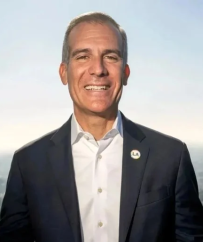
"We have to stop thinking of ourselves as tenants and firefighters and start imagining ourselves as engineers and architects." — Eric Garcetti (Former Mayor of Los Angeles; U.S. Ambassador to India)
Main Remarks
I recently was in this other city — you might have heard of it, it's on the East Coast, New York — giving the commencement address at my alma mater, the Columbia School of International and Public Affairs. It's a very international class: about 32% American, and more than two-thirds international, from 70 countries. About a third go into diplomacy and international development and human rights work; about two-thirds go home to work inside their own governments.
I started those remarks by confessing that when I sat in their seats, I hadn't fulfilled my statistics requirement – it took me two years after graduation to actually get the degree. So I told the ones who hadn't finished their requirements yet, "It's okay, it's going to turn out all right." But then I turned to the state of the world and said: it really must be a frustrating moment to graduate, because you look at the world and you literally and figuratively see it on fire. Literally, with rising temperatures; with the flames of war in Africa, the Middle East, and Europe. And metaphorically, because it feels like the very building we've been living in is itself burning down.
Sticking with that metaphor: whether we're talking about our domestic democracy or the international order that has defined not just this generation but the two, even three generations before, that have lived in the most stable buildings, maybe in human history, certainly in modern history. After the ashes of World War II, after two great wars and a worldwide depression, the architects and engineers of that postwar moment built something. Our own country, through all our mistakes and shortcomings, shared that same aspiration: to build a stable democracy at home and a stable order globally. That international order gave us things like the United Nations – a single place to have our arguments and do our work – the Bretton Woods system for financial exchange, NATO to contain the war that had spread across the world, and the list goes on.
I think a lot of us in this moment wonder what's causing the fire in this burning building. The easy answer is: our nation's leader, a kind of political pyromaniac who threw a Molotov cocktail through the window. And people of good instinct tend to play one of two roles – sometimes both at once.
Either tenants of the building, because it's the only one we've ever known, nostalgic for what it was even with its shortcomings — a building that consigned the Global South to the basement while the Soviet bloc argued about the interior decorating but never actually left. We're nostalgic for that stability, hoping we can just put the fire out.
Or we're firefighters, reacting to the flames, hoping that another election, another court case, or an appeal to human decency lets us go back inside, patch it up, and live out our days there.
But I'd argue we're convening here at VerdeXchange at a moment where, even without the pyromaniac, even without flames licking the walls — that building was already starting to crumble. So much is changing in our world that we have to stop thinking of ourselves as tenants and firefighters and start imagining ourselves as engineers and architects.
That's a tough call, because none of us have ever had to do it. Most human generations have had to build something, often several different structures, for trade, for security, for the environment. And some generations saw their buildings built and rebuilt two or three times in a lifetime. But for us, we've never had to. We've had the luxury. Maybe we've gotten lazy, because we don't have the muscle memory of knowing what it means to construct an order. But make no mistake — that's exactly what this moment calls for. We can't be thinking about tinkering around the edges or redecorating the rooms, we have to think about what the structure of the next building actually looks like.
I like calling that the civic substrate. Before the foundation of a building comes the substrate — how you prepare the ground to hold it. To me, that civic substrate looks like gatherings like this one, where we get off our feeds and see each other's faces.
Take climate. On the feeds, you'd think we're losing the battle, that we're on defense because of our national leadership. I now represent C40 Cities as Ambassador for Global Climate Diplomacy, representing cities of the world inside the UN COP system and if you went to Brazil for COP and just read the headlines: no American federal representative there for the first time ever, the petrostates closing ranks, and no real agreements coming out of it. That's one headline. That's what's in the feed.
But on the other hand, looking at the work on the ground, in places like Los Angeles. There's exactly one country in the world on track to meet the science of the Paris Accords. Guess who — it's not Germany, and it's not the United States. It's Denmark. Everyone else sets their own goals, and plenty are meeting theirs, but Denmark's the only one on track for what the science actually demands. But if you look at the 100 largest cities in the world, including Los Angeles: 75% of them are on track or ahead of it. And Los Angeles alone is the 12th-largest economy in the world, it’s as complex as any nation. If cities can do that work – and in Brazil, every other country's delegation was stunned that the second-largest group of elected officials at the table, after the Brazilians themselves, were Americans – then the work is clearly continuing at the state and local level.
And you'd be surprised where. The feed says climate is now a red-and-blue issue in this country, no longer a green one. But 70% of the new renewable power installed in America last year went up in three states: Florida, Texas, and Ohio; all under Republican leadership. Climate Mayors, which I co-founded and used to lead, is now over 300 mayors – Democratic, Republican, independent – working with counterparts in Canada on the implementation of what our work has to be.
Algorithms and autocrats want us depressed and afraid. That's how they hold onto our eyeballs and our votes. But hope — a dogged determination to actually look at the data — tells the truth of where we are. Those of you who know me know I'm an unabashed optimist, but it's an optimism rooted in the actual work that is happening. My friends in venture capital and private equity in the green space say it's never been a better deal flow for cheaper money. I just came from a World Resources Institute board meeting in London, where people were talking about how embedded this work already is – but also letting us know how we need to talk about it differently. Reclaim the optimism and the ambition, and stop being so brainy about it. That's good advice for the Democratic Party right now, too but a ten-point plan doesn't convince anyone to vote for you. But if you talk to people about their safety, their neighborhood, their jobs, their well-being, about building prosperity, people can relate to that. People want to be healthy, safe, and able to provide for their families. That's what this work is actually about — not the tonnage of carbon. Leave that count to the people whose job it is to count it. Let those of us trying to win hearts and minds get back to what inspires us.
Which brings me to something I believe can genuinely inspire us – because I've witnessed it, not as a politician, but as a 13-year-old boy in 1984, when I saw the world come to my city. There are very few things left that go to the heart of our ideals as human beings the way this does: a place where everything supposed to divide us just falls away.
Growing up in LA, I came to understand the cliché that you can see the face of the world on the streets of LA — and it's truer here than in probably any city on Earth. Every time I left LA, whether as ambassador to India or as a student or tourist abroad, I saw the face of Los Angeles on the streets of the world. Being from here, you feel comfortable in Berlin, in Cairo, in Tokyo, in Mumbai, in Mexico City — because they look like Los Angeles. The cultures, the languages, the way people move through the world — it's in our blood. So, LA has always been the perfect place to host the Olympics.
And a dirty little secret about our Olympics — we'll get into this more on the panel — we've never actually won a competition to host them. We bid for 1924 and lost. Then the great Depression hit, and in '32 the IOC basically said, "Why don't we give it to that town near Hollywood?" They couldn't even remember the name Los Angeles. That '32 Games put us on the map.
By 1984, the Games had nearly bankrupted Montreal, and nobody wanted to bid. After the Moscow boycott in 1980, it came down to Tehran and Los Angeles — and then something happened in Iran, and suddenly it was just us. They said, "Take it." And we did, with a new model that changed the Games. This time around, after five cities became four, became three, became two in the bidding, we suggested giving it to both finalists. They said no – no city gives up its once-every-four-years turn in the spotlight voluntarily. Three months later, they called back: "What if we gave it to both of you?" I said, "What a great idea." That's how we got our third Games with no competition at all – joining London and Paris as the only cities to host three times.
Another dirty little secret: the Olympics never lose money on operations, only on capital costs. So when we said we'd be a "Games changer" for the third time and actually do this sustainably — since everything we need is already built here — we meant it. No new Olympic Village. No new subway line will be built just for the Games and abandoned after. No arenas sitting empty afterward. No whitewater kayaking facility — that one's going to Oklahoma City. When you actually show what sustainability and reuse can look like, you get to say you can pay for the Games and maybe even come out ahead, like we always have.
What the Olympics are genuinely good at is putting a few points on the horizon and inspiring people to march toward them. So today, I'd ask you to open your minds to what you want to see here, the way we did in 1984. 1932 was the 10th Olympiad we hosted, so we turned 10th Street into Olympic Boulevard. In 1984, we made Olympic Boulevard and Pico one-way streets and proved traffic could actually move through this famously impossible to navigate city. What will we do on those same streets, or others, to leave a new legacy in 2028?
In 1932, we invented the Olympic podium, the Olympic Village, the photo finish, some of the first women's events, and hosted China's first-ever Olympic appearance. In 1984, we brought the Games back to the Coliseum, had Rocket Man fly in, and ran the first wheelchair marathon — the event that helped launch the Paralympic movement, among other things. What will 2028's legacy be?
I remember, during our bid, an African member of the IOC – a former athlete from a small country, nowhere near the world stage of America or the Soviet Union – telling us about marching into the Olympic Stadium. He said: for one moment, walking in, he, his country, and his membership in humanity were worth just as much as anyone else's. That's what you see in the Olympic Village — North and South Koreans sharing a meal, Israelis and Palestinians doing the same. At a moment when I think we're all still hungry, when we close our eyes at night, for a world that feels different from the one on our feed— the one so many of our leaders push — this is our chance to help write that moment ourselves. Not to sit around, the way LA sometimes does, treating the Olympics like some golden baby that needs feeding and raising while saying, "I won't feed it unless you do what I want — fund my program, raise my wages, cut my taxes."
Instead, let's recognize we have a shared responsibility to raise this child together. If we do, we'll get to see a better city, and a better world, than we ever have.
- Log in to post comments